Search This Blog

Thursday, April 12, 2012

Mission Journal March 13-April 8, 1899

Carl Oscar Johnson’s Mission Journal – pages 74-84

March 13-April 8, 1899

(74)

I left this place with stirred feelings because the people accepted me so well and they showed a great attentiveness as actual brothers and sisters [i.e., members of the Church].

Wednesday the 15th. I went to Korsamon and visited the J. [Jonas} Selanders after which I walked further to the Aslins where there was a meeting  scheduled that night and for me it was as usual there at [that]home where I feel happiness and peace.  Many of my friends from Westana were there and a joyful meeting in the word’s fullest meaning [took place].  After the meeting I heard word that some were thinking of baptism and I was happy that hope for a harvest was before us.

Thursday the 16th.  I was a guest at the Larsons that entire day until evening when we were a company of 18 persons who walked to Westana.

(page 75)

and what would those think who were opposed to us  We had a good and enjoyable meeting also this evening, and it seemed that all were members of the church [lit. brothers and sisters].  After the meeting ended a baptismal service was scheduled for the following day and I felt still better.  I was invited to the Bergvalls over night and it was pleasant there.

Friday the 17th.  I visited the Bergmans ad then I went to the Aslins and we sought a place for the baptism and it was shown in a dream to one of them who came, namely Brita Larson, and when we found the place it took only 10 minutes’ work to get it ready [and]it called forth our surprise when it was so appropriate in every way.  Thereafter, a lot of people came and I baptized 6 persons, 3 men and 3 women which were the first in this parish who can be proven[to have received baptism], but which (page 76)

 likely are not the last.  And when we had confirmation the Spirit was so richly enjoyed that I felt a great power, and all felt it, and 3 of those who were baptized, who were previously ill, afterwards felt healthier than for a long time.  [Note:  Thos baptized probably were Brita Aslin Larson, Johanna Carolina Aslin, Sigrid Katerina Aslin, Simon Emil Aslin, Erick Jonas Aslin(?), and Lars Larson.].

We had a glorious song and music [time] together for a couple of hours and we [then] separated in great happiness and my wish was to quickly have another similar opportunity again.  I went with [the group] to Westana again and was with the Bermans until the following day.

Saturday the 18th.  I left Westana and walked to Boda and visited the Ledins and went farther to the Lindes and was there a while and later [went] to Kristoffer Johnson and there had a meeting the same evening, and on Sunday I continued with

(page77)

a second meeting and I had the happiness to send 2 of my friends from Kranga, Theodor Linde and Alida, and was glad because then I had help to play [instruments=probably guitar] and sing, and in that way it was a great help to me.  It seems as though here also there are good people and a good spirit was enjoyed and [I have} hopes for a harvest.  And I was very well met by those who opened their house for the meeting.  Sometimes I felt at thought I should be tired, but it went [well] anyway, and I was richly blessed.

Monday I left Johnsons and took a trip to Fors or Bispgarden and spoke with some places in the village and asked about a room in which to preach, but there were none who had such available.  I [stayed, or rejoiced(?)] with the widow Westin [The word ‘fastade”, or “stayed” really doesn’t match the context, which is ‘visited”.  If he misspelled the word and meant “festade”, or “rejoiced”, the suggestion of a happy reunion of friends in a religious setting would be appropriate].  I went back to K. Johnson and was there overnight.

(page 78)

The next day I walked to Garkvisle, but on the way I visited Ledins in Boda and was well taken off by them.  Arriving at G.[ark isle] I stayed with J. Lid berg and there was also a meeting scheduled for the next week.

On Wednesday I went to Westana and visited Nordlund and was there for a time.  I was to a couple of other places and heard that the congregation’s [parish] priest had been there and forbidden the people to receive me or offer a room for meetings, but had be the people were free in their thoughts so that the prohibition had no effect.  I was with brother and sister Bergvall overnight.  And the next day I was at the Bermans and Alvars as well as having a rest day. 

Friday the 24th.  I visited several places on the way to Krange and when I came there I was, as usual, very well-received and was with

(page 79)

 brother and sister Larson and we were together un 12 o’clock at night, and had music and song and joy.

Saturday the 25th.  We had a meeting at Aslins at 11 a.m. and there were many people there and a good spirit prevailed, and I had another meeting in Westana at the school at 7.pm. and I heard that there were some who wanted to enter the congregation [i.e. join the church} and I was happy for that.  I walked to Krange and was there overnight and on Sunday [Mar 26} we had a meeting at Selanders at Korsamon, and it was one of the best I have had, and such a great power of the Lord’s spirit was enjoyed that I had not the least effort to speak, and several were scheduled to be baptized, which ordinance was performed between 5 and 6 p.m. when 6 people went down in the waters of baptism and made a covenant with God to serve Him.


(80)

There were between 50-60 persons who witnessed the ceremony but the greatest calm and quiet prevailed and many eyes were wet with tears.  All was under the Spirit’s guidance and so was it when confirmation(s) were done, and it seemed as though this was a powerful testimony for many and probably will never leave them.  At 8 o’clock in the evening we had breaking of bread [i.e. the Sacrament] together and this meeting will be in my memory for a long time, for the power of the lord was so richly enjoyed that all could remember it. In harmony with the wishes and desire of all, Brother Alva was ordained to be a Priest in the church of Jesus Christ of Latter-day saints, and was also set apart as temporary leader [of the group] until a more complete organization could be accomplished, and we separated after one of the most auspicious days in our life according to several testimonies and I felt myself very satisfied with this day’s work.  [Note:  As nearly as I can understand from this diary, those that were baptized this day were Alida Kristina Aslin, Sigrid Catherine Westman (Aslin), Josef Fredrick Theodor Lind, Jonas Lidberg, and possibly Jonas Magnus Alvar and Frida Edholm.  It is unclear when Erik Jonas Aslin was baptized, but his name is included in the register of ordinations in the diary.  Other family records should be compared for exact dates.}

(page 81)

Monday the 27th.  I visited with brother and sister [“sy”], or syskonen=brothers and sister} Larson and later Selanders where I was for a couple of hours and spoke with them and it was very incorporating [inclusive, or joining together] of all that belonged to the Gospel and with a desire to become one with God’s people.  In the evening of the same day we met with Aslins at Krange and it was one of the best meetings I have held, and my thoughts were [that I should]not come any more to this area so I took a find farewell of these dear people with whom I had established such a good acquaintance.

Tuesday the 28th.  I was then staying with the Aslins a time when a message came from the Selanders [Jonas and Martha and possibly, Ingrid Mart. Selander] that they wanted to be baptized, so we performed that ordinance at 1 p.m. I t was a real pleasure to welcome these good people into the congregation as covenanters.

(82)

I departed from them and visited several homes and I was wonderfully greeted where I came.  I didn’t come to Garkvisle until just before the meeting time and there were many people present.  The meeting was at Olof Johnson[‘s home] at Storbacken. {Another meeting] was also announced for the next evening, and the next day I wrote several letters and visited the J. Lidbergs and talked with them.  That night there came an overflowing of people and 8 of my dear brothers and sisters from Westana came with their instruments and that was a remarkable gathering, and I had to promise that I would return again for the purpose of baptizing.

The next day I left that place and went to the village [possibly Liden} and there was also a meeting scheduled there at Mrs. Lindgren’s home, which also was plentifully visited by many honorable and attentive listeners.

(83)

I also had a meeting at the same place the following evening which was Good Friday.  The parish priest had gone about and forbidden the meeting, but that availed nothing because the people [determined] to come to the house of E. O. Berman, and sister Christina [Alida Kristina Aslin?] was there from Westana, and so I help to play [music—Alida Kristina played the guitar and sang].  Here also there were a couple who announced that they would be baptized if I came back gain and I promised them.  I lived with the Hagstroms while I was there.

(84)

Easter day, the 2nd of April.  I walked into the city [Sundsvall] and a meeting was scheduled there at 11 a.m. and I took up the greater part of the time speaking to those present.  We were then invited to the Hoglunds for dinner and were there the entire day.  I had several l letters with good news.  The next day I had all IO could do to get the reports prepared to be sent.  Later we were invited to Klara Schader for the evening and there were many of us there.  On Tuesday and Wednesday I was home and began writing for the branch’s part and when I had completed the narrative [or description] and because I was behind in my writing, I needed to do it to the last [minute before] we were at Sister Engberg and had dinner and so forth there.  I had no more duties the entire week than to send the Nordstjarnan [the North Star, which was the mission periodical] and visit several places and prepare to leave Sundsvall after about one week.

Tuesday, March 20, 2012

NOTICE OF RESUMPTION OF ACTIVITY ON THIS BLOG

I have been inactive on this blog for several months, but feel the time has come to resume activity.  Therefore, you can expect to see new and/or revised materials and pictures in the future.  I am sorry for this long hiatus, but hope to remedy that now.  Carolyn Johnson Christensen

JOHNSON, CARL'S MISSION PIX

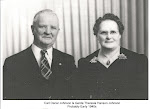
This is a picture of Carl Oscar Johnson that appeared in the book, "History of the Swedish Mission". I have added this picture to any materials on this blog that are concerned with Carl's missions in Sweden.

JOHNSON, CARL OSCAR'S MISSION JOURNAL - pages 67-73


Carl Oscar Johnson’s Mission Journal – pages 67-73

March 1-13, 1899
 (67)
[Note:  Johnson has misnumbered this page as page 67 even though it should be page 69, and thereafter in his diary continues the error in pagination.  I have used his page numbers as written despite the error.]

Therefore, some of them left that [meeting] place and went home even though there would [eventually] be a meeting, and at 7 p.m. many people came from their homes to us so that we had a full house, and I took the time to speak.

We slept overnight at the Ostlunds and the following day we visited many places and at night we walked to Boda and held a meeting there at one Hogelin but it was not filled with as many people as usual because notice had not been very wide spread.  We stayed at the Olof Ledins overnight and the following day, and had it very well with them and conversed much about religion and other things.
On Friday we walked to the Bermans in Westana because we were invited to stay the day with them, but we also were invited to other places and it seemed that all would have us as guests.

(68)
Regarding the people’s so great friendliness, it will be hard for it to disappear from our memory. On Saturday we walked to Kranga because a meeting was scheduled there but along the way we were invited into a couple of places.  Ewe were well received at the Asllins [Oslins] and had a very good meeting on the appointed night, and many people were there.  I spoke to them the whole time and I felt very good about it, and a meeting was scheduled for the following day.

Sunday the 5th [of March].  We had a time for song and music before the meeting began and after that Brother Anderson spoke for a time after which I began, and it was so good to speak in these meetings that we did not need to tax ourselves in the least.  There were some who after this [meeting] expressed a desire to be baptized and said that in the near future they wished to enter the Church.
(69)

We left this place and visited a couple of places along the way to the John Ostlunds where people were already assembled, and so we once again had a good meeting and many people were there.

Once again there were attempts to oppose us in that a preacher Hanson who belonged to the United [Moravian} Brethren was called here to work against our activity but that also was to our benefit.  Several of their members were expelled because they had taken me in. Others left [the United Brethren] on the ground of the lack of love and the hate which prevailed, and it appeared that the entire congregations was about to disband and I expect several of those good individuals to unite themselves with us.

Monday the 6th.   I went in company with Brother Anderson to the Nordlunds because he will leave to go back to Sundsvall and I shall stay and continue the work.

(70)

I visited the Alfvars where I was for 5 hours and talked with them about the Gospel, and they were very happy about my visit with them.  Later, I walked to the Bermans again because I had as it were my home with them and their wish was that I should stay with them.

Tuesday the 7th.  I was there until afternoon when a girl came and asked me to go to their home and I went and was well-received.  Those people had been expelled from the United [Moravian] Brethren congregation.  There was another meeting at the school at 7 p.m. and many were there even though it was so cold, and the people showed me the greatest love and trust, and my fine singers were so willing to perform songs and music [instrumental?]to thereby improve interest and increase pleasure [in the meeting].   I stayed with the Bermans this night, also.

(71)

The next day I left the people there and went to the Aslins at Kranga where I was invited to dinner and we scheduled a meeting for the next week.  Later I visited with the Hodins and Selanders and was well-received.  There was a Mrs. Timmer who went with me to Langsjonaset and when I got there I was taken care of well by people [named].  Westerberg who also scheduled a meeting that evening.  IO then had my first meeting in this village and many were present there, and I sold 5 books after the meeting ended.  Another meeting for the next evening was announced.  Next day I rested and wrote my report and I had it very good at the before named people[‘s home], and we talked about all sorts of things.  And I reflected over how the mission could be maintained in this region because missionaries are needed to support it.
(72)
At night the house was again full of attentive listeners and we also had good music.  The following day I walked through the woods and came to Hellsjo and met Carl Nilson with whom I was slightly acquainted and who desired that I should be a guest at his home, and I was very well-received, and there was also a meeting the same evening at school and the schoolmaster attended it.  And there was also a meeting scheduled for the next evening, but when the people came and were assembled a person appeared who seemed to be very agitated in his mind and asked for my permit [to preach] and even though I didn’t know who he was I showed it to him, but when I found out who he was I criticized him for his behavior.  I was forbidden to preach.

 (73)

After a discussion between the people, Carl Nilson came and said that those who wanted to hear me should go home with him and we had an enjoyable meeting there, and I heard many different voices about the priest’s behavior.  I remained over Sunday and also preached that evening and many of those present appeared attentive.

Monday the 13th.  Carl Nilson drove me 9 miles to Langsjonaset and because it is unusual for me to ride, it felt wonderful.  I visited my friends there and was well-received and had a good meeting with Isak Selander and was there overnight with them.  I stayed over the next day and had a meeting the next evening g at the Westbergs which also was very interesting.

Friday, September 30, 2011

JOHNSON, CARL MISSION JOURNAL - page 58-68


Carl Oscar Johnson’s Mission Journal – pages 58-68 
January 21- February 27, 1899
(page 58-59)
I found the brethren at home and I felt that I wanted a couple of days’ rest because my feet felt very painful.  I was at home and inside until Friday the 27th and during that time I accomplished the writing I needed to do and studied and prepared myself for other mission assignments, and we even scheduled meetings at Sundsbruk and also at Pettersvik with the Walbers.
Friday the 27th.  In the evening we had a meeting at the Good Templar’s Hall at Sund [or Sundsvall or Sundbruk?] and about 100 persons attended.  Some of the congregation seemed to be a little agitated, but most were very interested and the opinion of several was that we should come again and hold more meetings.  We lodged overnight with the Engstroms.  The following morning Brother Bohman and I went home and on arrival I felt ill and had to go to bed for 5 hours, however I then began
                                                                                      (page 59)
to feel so good that I got up and prepared to go to Pettervik and hold a meeting there, and we came there just before the established time.  There were not many there, but it was good and instructional.

Sunday the 29th.  We had a second meeting at the hall but there were not many who visited these meetings so it appears that the people in this area are indifferent to visit and learn about the way to eternal life.  In the evening we were at the Hoglunds for a while and several of the brothers and sisters were present, and we stayed until 10 o’clock.

Monday the 30th.  I was home all day and wrote and prepared our monthly report and I was also unable to walk any distance because my foot feels very sore so that I couldn’t even put a shoe on it.  And the next day I was also at home.
(page 60)
Wednesday, February 1.  I traveled a distance to Fransta and visited Brother Strand and found that his wife was very sick and confined to her bed for 5 weeks.  I was very welcome and stayed with them until Sunday, and also had a good gathering on Saturday evening where the people seemed to be very interested, and I talked for a long time.  The next morning a man who was a member of the United (Moravian) Brethren asked me to stay longer and hold several more meetings, but time did not allow me to do that.  On Sunday morning, before I left, we had the sacrament together and had a joyous time.  Then I traveled by train back to Sundsvall and met the brethren who had just completed a meeting at the hall.  I presided at the last meeting and spoke part of the time.

                                                                                       (61)

We were at the Hoglunds that night.

Monday the 6th.  I was home till noon when we were invited to Sister Engberg and had a fine meal.  When we left there we went to Sy[Sister?] Lind and were there over the night.

On Tuesday I left in company with Br. Bohman for a trip southward and we walked the long way of 34 miles to Gnarpsbruk and found our brothers and sisters there in good circumstances and they were very happy with our visit, but we were very tired when we arrived.  We were there overnight and the following days and rested and amused ourselves as best we could.

Thursday we left Gnarp and walked 21 miles to Ravik Bergsjo and visited the Martinsons and then Brother Bohman had considerable pain in his leg just as the previous day when we walked to Gnarp.

                                                                                      (62)

When on Friday Brother Bohman continued to feel unable [to walk], I went alone to W[att?]lang and was there overnight and on Saturday continued to Hudiksvall.  Upon arriving there I went and greeted Sister Sundberg and soon received a little refreshment.  After which I took a turn around and visited [others], and I scheduled a meeting with sister Johanson for Sunday at 5 p.m.  I received night lodging with a folk, the Jacobson’s, by arrangement of Sister Sundberg.  I was there in Hjvall over Sunday and on Monday I  had two good meetings and acquired many friends and particularly of the Spiritualists Association, and several took farewell of me with tear-filled eyes, at the same time constraining me to come there again if it were possible, and I promised to half of them [that I would] and they felt happy with that.
(63)
Tuesday the 14th.  I walked 20 miles even though the weather was very bad, and I also had a meeting at the Martinsons which was very good [and] to the people’s satisfaction, and I also had a meeting there the next evening.  And some prominent personalities were also there, and the people even asked me to stay longer, but I dared not because I was scheduled to be in Sundsvall on Sunday.  On Thursday I walked to Gnarp but when I arrived I heard that it would not be possible to hold a meeting because the authorities would not give permission to preach in that place.  I was there overnight and that night many persons came to hear me because they had heard that I had come, but they could not [hear Johnson preach] and they turned homeward again, unhappy.
(64-5)
Friday the 17th.  I took leave of my dear brothers and sisters and had before me the long road of 34 miles to walk, but it went quite well so that before 6 p.m. at night I came to Sundsvall.  Of course, I was tired but I still had a little way to walk because Brother Bohman was sick and I wanted to see him, and I also visited Sister Lind who also was sick.  I had six letters from different places.

Saturday the 18th.  I was home and put things in proper order for the Branch and the meeting hall, and also visited some places, but I was quite tired from yesterday’s march.

Sunday the 19th.  We had a meeting at 11 a.m. and 5 brethren [probably brothers and sisters] were present and I spoke for about 1 hour.  After the meeting I visited Sister Klara Schader and others, and at night I visited (in company with Brother Hoglund)
(page 65)
the Salvation’s Army for I wanted to see them one time while I was in Sweden, but my thoughts were alternating while I was there, and at the same time I thought that they needed little more enlightenment.

On Monday I visited several places and prepared myself for a tour out in the countryside.

Tuesday the 21st.  I left the city at 10:30 and I [walked] the long road to Liden village (nearly 30 miles) but I [was]very tired when I arrived, and to my surprise a meeting had been scheduled by Br. Anderson at the Hagstroms.  I felt myself made powerful in spirit and spoke to the assemblage a considerable time even though my legs weakened.  There were about 60 to 70 persons present and they seemed quite attentive which made a good impression on me.
(66)
Wednesday the 22nd.  We left the village and walked to Sillre village (6 miles from the village [Liden], and when we got there we received work that a meeting was scheduled at Nils Pers [home], and we were well-received and at 7 o’clock there were about 80 persons gathered to meet, and I took up the time speaking and there was reverence and attention.  We had a good place to sleep and the next day we were there until 12:00 o’clock and spoke with the people there.  Then we walked 1 ½ miles to Jarkvisle where a meeting was scheduled at Nils Melin where I previously had had meetings, and we were well-received and had meetings 2 evenings at that place, and many people came together and a good spirit prevailed.  In the course of the day we visited several places and talked with the people wherever we went and they showed us much good, both food and friendship.
(67)
On Saturday we left Jerqvisle [Jarkvisle, or Garkvisle, or Gerkvisle] and walked to Westana and first visited the Nordlunds and were welcomed by them and we were then  invited to the Bergmans for lodgings.  On the way there we visited a couple of places so that it was evening before we arrived.  We were received with the best feelings and comfort.

Sunday the 26th.  We had 2 meetings at the school and in Johan Ostlunds home [literally, manor]. There was a full-house at both meetings although the religious [those with strong ties to a particular church] had a preacher here who scheduled meetings at the same times.  It is noteworthy that on few occasions has been shown as great well-wishing and friendliness as in this area, and the more that different churches have worked against us the more we have won the sympathy and trust of the people, and we feel ourselves filled with power to work among such good people.
(68)
Monday the 27th.  We visited various people along the way to Korsamon and we did not arrive before evening, and were very well received by the Selanders where a meeting was scheduled, and many people were there that evening as at other times when meetings have been held there.  Later, we had lodgings with the Modins.  The next day we received an invitation to attend a reading against us by a Baptist preacher.  We went and visited them [who send the invitation] and discussed with them the purpose for which they [the Baptists] accused us, and this discussion was very good for our part, and the reading was scheduled for 5 p.m.  We went there but the time was changed to 7 p.m., however, our meeting was scheduled so we could not attend, and the people could tolerate the change [in the preacher’s meeting].

Wednesday, September 21, 2011

JOHNSON, CARL - MISSION JOURNAL pages 52-57


Carl Oscar Johnson’s Mission Journal – pages 52-57

January 11-21, 1899

(page 52)

I stayed with the Olof Ladins not far from where our meetings were held and I had a wonderful home there with them, and they were as good as possible to me.

Thursday the 12th.  I took a tour up to Langliden because I heard that there was somebody who wanted to offer a room there, but at the agreed place they could not let it be used, so I let it be, but my feelings told me to go to another place, and there I was as good as expected and a meeting was scheduled there for the same evening, and I began to invite people to that location.  When I returned there was a request again from Boda to preach there again on Saturday night.  But I preach[ed] in 2 evenings on Thursday and Friday evenings at the Kristoffer Johnsons and quite a lot of people were there and [it was]very enjoyable to preach and the worthy people were very friendly to me.

(53)

I visited the Lindes at Langliden and was warmly greeted by them.  I also became acquainted with Ireius Ledin who has been in America for some time and he was very interested in the Gospel.  On Saturday evening I had a good and well attended meeting in Boda again and it now appears the spirit of the gospel has come upon the people more than before and they wanted another meeting the next day.  Because I will be leaving the area, I scheduled a meeting on Tuesday night.  After I was home with the Ladins [Ledin(?)] for a time, the school teacher, Akerlund came (somewhat heated) and wanted a debate which I agreed to and scheduled it to be in an open meeting at 3 p.m. on Tuesday afternoon.

On Sunday morning I left Boda in company with Linde  [Theodore? ]and was assisted across the river by A. Hammarstrom, then went further to the Selanders at Korsamon where 2 meetings were scheduled during the day.

(54)

There were so many people that they nearly filled 3 rooms and a remarkable power was enjoyed, and we had good music then.  One played the organ and 2 played guitars.  I felt true happiness to be able to work and be at this place when the people showed such an interest.  And several Langvadja[r] [Lanvagen residents] asked me to come to their homes for future meetings, however I could not because the time did not allow me, but I promised to visit them in the future.

Monday the 16th.  I said farewell to the Selanders and visited the Modins and was well received, and then walked to Westana and visited several places to which I was invited, and where I was especially well accepted, where I came and spoke with them about the gospel and its blessings, and several said they were prepared to obey it.  I was invited to stay overnight with the Bormans who also said they were believers.

(55)

Tuesday the 17th.  I visited Nordlund and was there for a while after which we went to the Alfvars and several were gathered there who planned to go to Boda [for the debate], and we were 7 in company.  Arriving there we saw people come from all areas gather in the school house, and at 3 o’clock it was as full as it could be, and the school teacher Akerlund took the lead position [and] received several questions which I answered from the scriptures, and which seemed to be to the people’s satisfaction.  My opponent misspoke himself a couple of times, but asked forgiveness and acknowledged that he was wrong.  The debate lasted for 2 hours.  Thereafter I had the most well-attended meeting I have ever had in the land, and spoke 1 ½ hours and I as well as the people were satisfied, and I hope that the truth shall bear fruit in this region and may God bless all those who have done good to me and who have shown me so much friendliness.

(56)

Wednesday the 18th.  I said goodbye to my friends in Boda and walked 4 1/2 miles to Garkvisle and visited a Lidberg who wanted me to come and hold a meeting there, and he has got a good place with farmer Nils Melin at which place I preached 2 nights, and many people were there and appeared to be attentive, and the leader of the United Brethren [Moravian] who was part of the previously mentioned committee, indicated he was very pleased and I was invited to return to the same [meeting] place.  Later a meeting was scheduled with Engom at Nils Lidberg so I had to go back one mile, and my friends from Westana came there and felt very happy to once again have an opportunity to hear a sermon and they wished me good fortune and prosperity and welcome back again, and that they would wait for that time,

(57)

and after the meeting’s conclusion there was a man who said he wondered if I would hold another meeting, so interested was he.  I went home with Jonas Lidberg and slept there over night.

Saturday the 21st.  I left Garkvisle and went to Liden village and the weather was nasty with much snow.  I stayed overnight with Hagstrom.  Next day I went to Ostloning Indahl and stayed with Lars Hogelin overnight and was well received at these places.  Next day I walked 20 miles to Sundsvall and because of the unclear road and [which made it] hard to walk, I became very tired, therefore I was glad to be home again and very satisfied with the work I had done.  I had [in value] over 23 kronor [crowns’ worth] of tracts and books with me when I went [to the Indals region]. (and) I had only 1 “The Voice of Truth” and “A Glad Message” for 17 ore (cents), and many books were contracted out [sold or loaned].

Tuesday, September 6, 2011

WALLACE JOHNSON FAMILY

THE WALLACE OSCAR JOHNSON FAMILY

Other pictures of Wallace and his wife, Fae, have been added to the Life Sketch of Wallace Oscar Johnson.

FAE DORA JOHNSON


FAE DORA JOHNSON JOHNSON


Fae was born May 24, 1919 in Basalt, Bingham County, Idaho, to Hans Andrew Johnson and Dora Chatman Hymas. Fae was the 7th of 9 children born to Hans and Dora—the 2nd of 3 girls.  Dora said Fae was very delicate when she was born and even though the weather was very hot she was kept with hot water bottles until the last of June.  There was no such thing as incubators at that time.   She was blessed by her father on June 26, 1919.

Fae started school when she was 6 years of age in 1926.  She skipped the second grade and graduated from grade school at the age of 12 in the year of 1932.  She remembered having to wear those ugly long brown stockings to school.  Many days she would roll them down to her ankles after she got to school as many of the girls would do.  However, one day her mother came to school for some reason or another and saw that her legs were showing.  What a disgrace!!  Fae was marched home with her mother switching her legs with a willow all the way home.

She was baptized in Shelley, Idaho on June 2, 1927 by Robert Bradshaw and was confirmed on June 3, 1927 by Bro. Joseph H. Dye at Basalt.

She went through all of her classes in Primary and graduated from the Seagull class when she as 13 years of age in 1933. She, also, received her Patriarchal Blessing on Feb. 12, 1933 by Bro. Joseph H. Dye.

Fae started high school in the fall of 1932 but didn’t complete her freshman year or go any farther in her education because of poor health.  In the spring of 1933, she had rheumatic fever and stated that she such a bad pain in her heart that she couldn’t lay on her side.  Her parents sent for Bro. Merkley and Bro. Cox, both from Blackfoot, and had them administer to her. When they got through, she turned on her side and went right to sleep.  

Her heart trouble was compounded with scarlet fever.  She was in bed for four months without even being able to feed herself.  She was administered to many times while she was sick and saw the power of the Lord made manifest.  Her heart was so badly damaged that she was told by doctors she would not live to see adulthood.  During one particular blessing, she was promised if she lived faithfully, she would live to see her family raised.  Fae’s father was upset at this promise because of her poor health. However, Fae’s parents had seen the power of prayer and the power of the Priesthood too many times to ignore this promise.  They knew the validity of it.

When she lived to adulthood and married, the doctors told her that she would not survive childbirth and therefore, she should not have any children.  When she had two children, they told her that she would not live to see grandchildren.  But she lived to see 5 of her grandchildren before she passed away.

Her service in the Church started at a young age.  She was sustained as a Primary teacher in 1934 and taught different classes.  She really enjoyed teaching the young Primary children.  She helped with the Sunday School.   On September 8, 1935, she was sustained as Assistant Secretary of the Basalt Ward.  January 27, 1936 she was set apart as the Jr. Genealogy Teacher.

In 1935 she attended a stake dance with some of her friends, namely Adele Jensen.  A young man named Wallace Johnson (no relation) was attending that same dance. Wallace’s friend, Hollis Harker, dared him to invite this pretty young lady to dance.  He took the dare and referred to this young lady as a red winged blackbird because of the black dress trimmed in red she was wearing that evening.  Wallace and Fae began a courtship that evening that turned into an eternal marriage on June 3, 1937, in the Salt Lake Temple.

Two children were born to Fae and Wallace.  Wallace Delmar was born on 5 June 1939 and LaNea Fae was born on 6 May 1944.  Both were born in Idaho Falls, Idaho at the L.D.S.Hospital

Despite Fae’s poor health, they enjoyed many activities together, especially fishing.  The family enjoyed many fishing trips together.  LaNea remembers one trip at Riverside when she fell in the river.  She was sitting on a rock dangling her feet in the water in the swift current—just a little further—just a little further.  All of a sudden she slipped in.  The water was up to her chin.  She was so scared.  All she could mutter was “ma”.  Mom was fishing from the next rock down—probably about 20 feet away.  With the sound of the rushing water, there was no way she could hear LaNea.  But somehow she saw her.  Fae jumped in so fast after LaNea and got her out of the river.  They headed back to camp which was passed Wallace.  He saw them, started to tease Fae about falling in but realized what had happened. He realized that was not the time to tease—too many tears.

Another memorable fishing trip had several people, including Wallace and Fae, fishing from a boat.  Two people hooked fish at the same time.  The first fish to be landed was dropped on the bottom of the boat with the flatfish still in its mouth so the people could concentrate on landing the second fish.  The flopping of the first fish caused the treble hook on the flatfish to become embedded in Fae’s rear.  The scene of Fae’s screaming, Wallace’s trying to console her and the other’s trying to land the second fish was quite exciting.

Fae was a very outgoing person.  She made friends very easily and had many friends. She was interested in other people and made others seem like they were her best friends. She served as a Pink Lady volunteer at the hospital for many years.  She loved to play bridge and belonged to a couple of bridge clubs. I think it was more just the association with others.  She was a member of DUP.  When Fae’s Mother was in a Nursing Home, the older ladies were always so glad to see Fae come because she would visit with them, too. Sometimes, Grandma would get a little jealous.  She would say, “I thought you came to see me!” She was plainly a very pleasant person to be around.  A niece Maureen, remembers Aunt Fae as being so pretty, and being so nice.

Fae was always involved in her children’s lives.  She was a room mother whenever she could be.   Her kids were always very proud when their mom was at school and participating in their activities.  Mom always went out of her way to make sure whatever she did was as nice as possible.  She took pride in her children’s appearance.  When, in Delmar’s senior year, he was voted as the “Best Dressed Classmate”, she said she took that as a compliment to her, because she bought all of his clothes.

She taught LaNea and her friend’s 4-H and attended 4-H Camp with them. She attended LaNea’a State FHA Convention in Boise as a chaperone. Delmar was very active in scouting with his Mom serving as his counselor on several of his merit badges.  Fae was so proud of Delmar when he received his Eagle.  Delmar gives credit to his Mom for this great accomplishment.   Her children have always been so proud to have her a part of their lives and their activities.

Fae loved working with her children in the church, also.  She loved being where they were.  When her children were in Primary, she was in Primary. When LaNea was in MIA, Fae served in MIA for a while. It’s a great blessing there has always a closeness in her family.

Fae was always very close to her parents. Hans and Dora lived in Shelley during the latter part of their lives.  Fae saw them almost every day.  Holidays were a fun time spent with the family. Christmas, Thanksgiving, and New Years were rotated among Fae, Maida, and Grandma/Grandpa.  The three families would get together each year.  The grandchildren’s responsibility each time was dishes EVERY TIME!! They would really complain but boy would they have fun.  I don’t know how clean the dishes really were but we did have fun.

Ila died when she was very young so Fae and Maida were the only sisters who really knew each other.  They were very close. They did many things together.  They laughed together; they cried together; they worked together; they fought together; they shared joy, sorrow and pain together.  They were true sisters.  They were so close.  There weren’t any sisters who were closer than Fae and Maida.  They worked in the spud harvest together.  Many stories were shared as they sat side by side at the spud hopper cutting spuds as Delmar shoveled spuds into that hopper.

Because of her health, Fae was not able to do much manual labor on the farm, but she surely was a good truck driver whether it be during spud harvest, grain harvest, or for the guys bucking hay.  She enjoyed being outside doing whatever she could do to help. Probably the most help she provided was the excellent meals she cooked for the help.  She was an excellent cook.

Wallace was well known for being an excellent farmer.  One year, corporate officers from French’s Potato Processing Company came to Shelley from New York.  They visited Wallace’s farm, but not only did they visit Wallace, they also stayed to partake of Fae’s good Idaho cooking.  They published pictures of Wallace on the farm and pictures of Fae in her kitchen as well as her recipes.

Fae loved flowers.  She always had beautiful flowers planted around her house as well as flowering trees.  One of her favorite trees was a deep purple lilac.  She, also, had a snowball tree.  When the two were in season, she always had a bouquet of the two on her kitchen table.  She also had a bowl of pansies when possible, too.

Fae loved red hair.  She said her natural color was a mousy brown color.  Her family never saw her natural color.  They always thought she had the most beautiful red hair.  Wallace called her “carrot top”.  Fae’s Granddaughter Susan had a daughter, Jessica, with the color of hair that Fae always wanted.  LaNea said Fae sent her to us for that reason.

Fae and Wallace loved to bowl.  For a number of years they bowled together in a league.  The condition of her health was reflected by the weight of the bowling ball which she used.  She started out with a 12 pound ball.  When that got too heavy for her, she went to a 10 pound ball.  She finally went to an 8 pound ball.  I’m not sure whether she went to a 6 pound ball.  She would stand for a long time watching her ball slowly roll down the alley.  The pins would fall down in slow motion but she would get the job done.    But when it became too strenuous for her to bowl, they retired from the bowling league.

The house Fae and Wallace lived in was heated by a central heater located in the living room.  Consequently, the surrounding rooms would get rather cold, especially during the winter.  Verna remembered how Fae would like to sit in front of that heater eating one of her favorite foods—Jonathan apples.

Another memory Verna had about Fae was the kitchen in that house.  Fae loved to decorate.  The kitchen was decorated in white, black, and red, which was rather daring in those days.  Verna said it was beautiful.

Since Wallace was a farmer, they lived about 2 miles out of Shelley.  Fae’s parents lived in Shelley due to Hans’ poor health.  Hans and Dora’s youngest son, Raeo, lived with Fae and Wallace and worked on the farm to help his parents.

Fae and Raeo had a very close relationship and remained very close.  In fact, Raeo and his wife, Verna, were able to go to the hospital on the day LaNea was born to see Fae.  This was the day Raeo was shipped overseas with the Army in WWII and was the last day the family saw him since he was killed in France the following October.

Verna also remembers what a devoted Mother Fae was to Delmar.  Delmar’s favorite story was “Peter Rabbit”.  He would love to sit on Fae’s lap to have her read him that particular story.  He knew it so well, he knew if she made a mistake in reading it to him.  He could almost read it to her.

For the last few years of her life, she lived from one new wonder drug to the next.  When the effectiveness of a new drug would diminish to the point that it didn’t help her, another one would hit the market which helped for awhile.  Eventually, she outlived the progress of medical science and they did not have another wonder drug to keep her alive.

Fae passed away on Jan. 18, 1968 in Idaho Falls, Bonneville, Idaho.

She was survived by her husband Wallace
Son, Delmar
Daughter, LaNea

She is buried in Shelley, Idaho

Friday, August 12, 2011

ALLAN OSCAR JOHNSON


Below:  Aldon, Edythe & Miriam Johnson


ALLEN OSCAR JOHNSON


Obtained from his daughter, Miriam

Taken from a Tape

My parents blessed me with the name of Allan Oscar Johnson and I was born in Murray, Utah, on April 20, 1905. I didn’t remember when we moved to Idaho but I was told that I was about a year and one half old when we moved to Idaho from Murray, Utah. We moved by means of team and wagon. This was in March when the weather was still quite cold. I rode the distance but I don’t remember any of that particular ride. My father managed to build a simple home and father farmed the place and did very well although he was very inexperienced.

One of the first things I remember was when I was about four years of age it was one of the first exciting things, Father was working in the field and mother wanted Gerda, my older sister, and I to take lunch out to father in the field because he was tending water and he couldn’t leave the water. We got about half way out to the field where father was and we saw what we thought was a big gray wolf and it scared us and so we ran back to the house. We dropped the lunch pail and spilled all the lunch and when we ran we were screaming all the way for mother and she came out and we told her there was a big gray wolf after us. She said no there couldn’t be. We said it was so. She went out with us and we happened to see this big gray animal and she said it wasn’t a wolf, but a big greyhound dog. It was so enormous we thought it was a big wolf. Any way, that scare left an impression on my life, as I was very young.

But the thing I remember was when I got a kiddy car for Christmas. It was homemade affair but it served the purpose.

I also remember when our family and the Olsen Family and the Anderson family decided to take a trip into the hills with us as a family unit and I remember Father making a whistle. I was whistling that for days. I do remember that trip. It was one of the exciting things of my life, something I will never forget.

And another exciting thing in my life was when I must have been around five and one half years old. Anyway, I was to start school and I needed a tablet and a pencil and my older sister said that she would get the tablet and pencil for me when she came home from school. We lived a mile and a half away from school and she had to walk all the way. When I decided it was about time she should be coming home, I decided to go meet her and I ran about a half-mile down to meet her just to get that tablet and pencil. That was one of the prizes of my life.

And also, when I reached the age of 8 years old, father bought me a bicycle, for me from Santa Claus. I learned later who Santa Claus was. Anyway, that was a wonderful gift. I really treasured that, and tried to take really good car of it.

There are several things that happened in my life, but some of them I would have to ponder on in order to put them in story form. I would like to tell you a little about my early chores that I had to do. I started going chores very young because I was the oldest boy in the family. We started thinning and hoeing beets when I was six year old. I remember too, I would help father cultivate beets. At that time we didn’t have modern tractor equipment like we do now. And we didn’t even have modern horse drawn equipment at that time. Father had a little two-row cultivator that had handles on it like a hand plow. It had bars underneath. It had a shaft under for a single horse. We hooked it up, too. Father couldn’t drive the horse and guide the cultivator too. So when I was very young, I would ride the horse and guide the horse and keep the horse from stepping on the rows of beets. I didn’t succeed and the horse stepped on the row. Whenever the horse would step on the row of beets then father would give me a little lecture. So I had to be very attentive of where the horse would put its feet. But anyway, we accomplished the job of cultivating the beets that way.

It was later that we got a larger cultivator that used two horses instead of one. And a person could drive the horses from a seat on this cultivator and guide the cultivator with his feet, up and down the rows. Now the younger people of today probably don’t even remember this machine. It was a modern machine at that time. I started plowing with a team when I was twelve years old. We had two horses. One was a fast horse and one a slow horse. I always had to hang on the fast one and hold it back so that the slow horse would do a little of the work. And that really put a drag on me and made me very tired. I would have to sit down in the furrow and rest occasionally. Well, I would like to give some more later but at the present time this should suffice.

New Tape

I’d probably like to start about the time I was called on my first mission. I didn’t hardly feel that I was ready to go on a mission yet. When I had my interview with my Bishop he felt that I should prepare to go on a mission. He said he would give me a month to think and pray about it. This frightened me as I didn’t think I was well enough versed in the Gospel. I talked it over with Father and Mother. They were thrilled to have me go. They suggest that I start studying more, so I consented.

I was ordained an Elder and in the Elders group meetings I received a lot of help. I questioned my testimony. I prayed for a testimony. This worried me quite a little so I decided that I would have to do a lot of praying to get an answer, some kind of assurance that was the thing I should do. So I did each night and then one time I happened to have a dream and I woke up at the close of this dream and I determined that this was in answer to my prayers. I dreamed that I was out in the filed watering potatoes and I had a stream of water coming down the ditch. And it necessitated working real fast to get the water set in as many rows as possible before the stream got there and so I was working real hard. And while I was working I noticed that the atmosphere was getting darker. So I looked up and saw heavy black clouds approaching. I thought it looked like we were going to have a heavy rainstorm and then I realized that it didn’t seem like rain clouds but smoke, I observed that it was fire. So I dropped my shovel and started running.


I felt impressed to go to the Church. I was closer there than I was home, so I ran as fast as I could. And as I ran I didn’t realize that I had heavy boots on and so by the time I got to the Church I wasn’t sure if I was going to make it or not. I was so tired. I didn’t know if I could make it at all. I soon became exhausted. I finally made it there. The Bishop was just ready to close the door. Just as I got there and before he closed the door I looked back and the trees across the street were bursting into flame one right after the other in sort of a chain reaction and the Bishop closed the door. We were in there for some time. I don’t know just how long we were in there. I don’t have any idea how long it was but we were pretty suffocating for the want of fresh air as the church was pretty well filled up and finally the Bishop said it was all right to open the door and we opened the door and all the landscape was black between our building and the 1st Ward Church which was the other side of town. Before the fire there was a lot of trees and buildings, we had no chance of seeing the other church and when we came out after the fire then we could see the other church standing there all alone. And I decided this was my answer, that I was representing the True Church. The lord was telling me hat those who are valiant in the church shall be saved when the earth will be destroyed.

I told the Bishop that I would go so we prepared the paper work and when the papers came back with my call, I was called to the Swedish Mission. So I went into the mission field with this dream on y mind. I went for a long time and never said anything to anyone. I believe I told Rula about it but I was afraid that I would be ridiculed for dreaming a dream, that really sounded foolish, when I mentioned the trees bursting into flame in a chain reaction. Several years later some scientists were reporting on the Atomic combustion and he mentioned in his report he feared that sometime in the future they would create some kind of explosion that would create a chain reaction of the atmosphere. With that in mind that went along with the dream I had, I felt like I could mention it without being ridiculed. That was the first experience I had that the lord does answer prayers. And the testimony that I would like to bear at this time is that the lord does answer our prayers if we are sincere and persistent in trying to receive an answer for a just cause.

Well, when the time came for me to leave on my mission. I got the call in December 1923 and I was to leave on the 2nd of February 1924. There was quite a lot of snow on the ground at the time when I went down to the train. When the train came, we exchanged farewell greetings. Mother had tears in her eyes when I boarded the train. The family was there and a few other people. At that time we didn’t have a Mission Training Center. We remained in Salt Lake long enough to go through the temple and be set apart for our mission, and receive our papers and instructions then we would take off. I tried to get a visa in my passport. I was called to the Swedish mission but the Swedish delegate there in Salt Lake City refused to sign my visa so I was told to stop at Chicago and try to get a visa there, but failed to get a visa there either for my passport, so I went on toe New York to try again to get a visa for my passport.

B. H. Roberts was the President of the Eastern States Mission and he tried very hard to encourage them to give me a visa. We learned that they had a campaign started in Sweden against the Mormon Missionaries. Anyone born out of the country was having difficulty and those born in the country were the ones who could go into the country and do missionary work.

Anyway, In New York, when I was refused there, they decided I should go on to Oslo, Norway because the boat was going to land there first and then from there on to Copenhagen, Denmark. That was the thing we did.

I would like to mention the experience I had with Dr. B. H. Roberts, one of the most thrilling experiences I have ever had in my life. He was a great spiritual man and he did so much to encourage myself and other missionaries who were traveling to other missions in my same group. And I learned to really appreciate his great writings, the church history and other writings.

As we had to wait for two days for an appointment to the Swedish Consulate when we arrived in Oslo, Norway, we decided to go with some other missionaries to a ski resort and enjoy the World Skiing meet. That was a wonderful experience, watching the ski champions from around the world perform. We had a good viewing spot close to the king’s platform. Skiers would come down the run reaching speeds up to 80 miles per hour. When they left he ramp and would fly through the air several hundred feet before they came down to the runway again. Some would fail to remain upright on their skis. They would go on down the slick slope on their stomach, back, seat, or however. One skier broke a leg and had to be carried off on a stretcher. This experience helped to ease my concern about getting a visa.

The next day we went down to the Norwegian Embassy. We also learned about a new leader who had pledged to slop the work of the missionaries for the Mormon Church. A decision was made that I go to Denmark and try again. If that failed I could stay in the Danish Mission. An older missionary, who had boarded the ship at New York, left me at Oslo, Norway. He had received his visa. He was born in Sweden and had come back to visit his native land. He boarded the train at Oslo, which took him across the country to Stockholm, Sweden.

On our way to Copenhagen, Denmark we had sailed for a half-day breaking our way through rather thin ice up to six inches thick. We finally hit ice that stopped the ship. They would reverse the ship for 1000 feet or more, then make a run for it and hit the ice. This would jar the whole ship. It would grind the ice four or five hundred feet and stall. After the third try they decided to wire and have an icebreaker come to our aid. We waited for about 20 hours before the icebreaker arrived.

In the meantime the captain permitted some of the passengers to climb down a rope ladder to play on the ice and go out far enough to take pictures of the ship. When the icebreaker did arrive, it was interesting to see how the icebreaker did its job. The front of the ship was sledded back some distance. The force of the propellers would cause the front of the ship to sled up on the ice. Then the weight of the ship would break the ice down and the chunks of ice would pile up on the sides of the ship and allow it to pass through. Our ship followed in the path made by the icebreaker. We finally arrived in Copenhagen, Denmark after six days from Oslo, Norway. It was an interesting voyage. We saw a few other ships stalled in the ice waiting for help. But when we did get to Denmark, the visa was again refused.

After about a month’s effort they decided they would agree to sign my passport visa on condition that I should do no propaganda work about Mormonism B just visit with family and friends there. We contacted the mission president and asked him what we should do. We were told to sign the affidavit and they would try to correct the condition from inside Sweden. I received permission from the Mission President to go to Sweden. They though they could get it straightened out when I got in and so I proceeded to proselyte.

I proceeded in Stockholm. There I was again refused a visa but I was permitted to stay in the country to visit friends and relatives for two months. It was agreed that I could probably do some missionary work while visiting with friends and relatives, which we did. I was finally sent up to a district. I had been there about three months when I received worked from the mission president that the authorities knew where I was and they were on their way up to escort me out of the country. I had been in the country then three months beyond d the visa period that I had. When I learned that the authorities were coming to pick me up I was told to pack up and come to Stockholm, which I did. And when we got there the conference president went with me down to the police station and they gave me a six months jail sentence for remaining in the country without a visa, that didn’t set too well. One of the conference authorities said that I could try again and if I failed I could preach to the prisoners. I made the remark that I had been called to teach people and not to the prisoners.

We reported this to the American Embassy in Stockholm, also we notified Senator Smoot in Washington D. C. As a result of this I was released on condition that I would leave Sweden within ten days and they decided to send me to Denmark. There I learned that other missionaries who were born outside of Sweden also had similar difficulties.

I went to Denmark and served there for about six months waiting for a transfer. After waiting for some time in Denmark, waiting for a transfer to a permanent mission, I was having difficulty changing to the Danish Language to teach the Gospel. My mother and father were both born in Sweden so I was somewhat familiar with that Language. In the meantime President McKay who was serving as the Mission President of the European mission finished his mission and left shortly after I had gone to Denmark and Dr. James E. Talmage was the new mission president. And for some reason or other the records that I had been sent to Denmark had been lost and I continued working there thinking this is where I would be serving. I finally received a letter stating an apology for forgetting that I had never received an official transfer and the transfer said that I was to go to England. So I labored for 5 months in Sweden, 6 months in Denmark, and 14 months in England. I did have a lot of experiences in all three.

One time my companion and I decided to try going without purse or script. And so my companion, who was from Layton, Utah, went with me and we walked up north through the timber area. We walked the biggest part of the day to try and reach Farling, (Denmark) and when we got there we were very hungry and this was a place where there were a lot of berries. We ate these berries to relieve the hunger we felt and then we walked to try to find a family by the name of Lars Anderson. A short distance from Farling there was a timber cutting settlement. We located this Lars Anderson and he was so happy because we were the first missionaries he had seen for several years. And so he took us in and fed us, which we appreciated very much and then helped us arrange the use of this one room schoolhouse to hold meetings in. This was done and we advertised as best we could through talking to some of these men down at the lumber mill. And when we held the meeting there was only two people that came in and sat down. We noticed that there were a lot of people outside so we went out and tried to encourage them to come in and it didn’t seem that we had any influence on them. Finally after quite a bit of time and one of the fellows that had gone inside went out and talked to them a, about a dozen people came in and sat down and so we started.

We started the meeting with a short introduction then my companion who had a better command of the language was going to give the sermon. While I was talking another person sneaked in a just casually and he sat down in the back, and so we proceed with the meeting. After the meeting, we went back to visit with the group and get their response and several of the people rushed out as fast as they could, but we have a good meeting with some of them.

Then we were to locate Lars Anderson’s family and so we asked Brother Anderson where we could locate his family. He said one of them lives too far away to walk but another lived about 10 miles. We asked for directions to visit him but he said you wouldn’t’ find him by the name of Anderson. His name would be Larson. In as much as his first name was Lars, so the son would be Larson, so we ventured forth and found his son and his family and we had a fairly interesting conversation with him. But he was hesitant to take on any responsibility to further the work of the Church. That concludes that experience. We felt that the effort that we put forth in attempting to travel without purse or script to teach the Gospel was successful to a degree.

Experiences in the civic and general temporal field by Allan Oscar Johnson

In 1933, after President Franklin D. Roosevelt became President, he introduced the Agricultural Adjustment Act (AAA) to improve the plight the farmers were in. This called for organizing the farmers so they could work towards bettering their condition. This organization extended from the grass roots, the Farmers themselves through to the Secretary of Agriculture (Secretary Wickard).

At the meeting of the farmers in Shelley, Idaho District, I was elected chairman. Three others were chosen to represent committees in the district. We met to discuss programs to help the farming industry. An allotment program was adopted to limit production to maintain fair prices to the farmers. The State committee was allotted so many acres, which was distributed to the counties. These allotments were distributed to the various committees. We in turn divided our acres to the farmers in our district.

We also had to police the farmers to see that they did not over plant. If they over planted, they were penalized. I was reelected chairman for each year for six years. At that time the county was reorganized. Philip Dance was made county chairman. I was made vice chairman. After one year Dance resigned and I was again elected chairman.

This is a part of the history that Dad wrote himself, so please excuse the duplications.


I am Allan Oscar Johnson, the second child born to my mother and father. I was born on April 20, 1905 in Murray, Utah. My father worked in the smelters there in Utah. When I was about one and a half years my parents moved to Shelley, Idaho to a farm there that Dad had bought. He was very new to farming and so he had to learn the hard way to farm. He had to learn the farming trade pretty much from scratch. As I got old enough and could understand a few things, I would follow father around and learned quite a bit in my early years of life.

One of the earliest things I remember about school was about 5, my older half sister was going to school in Shelley and my folks gave me a nickel and a penny. The nickel was to buy a tablet and the penny was to buy a penny pencil and it was very hard for me to wait for her to come home because she was going to buy them for me and bring them home to me. I remember how thrilled I was to receive it. I did a lot of practice writing, or course, most of it was scribbling. I learned how to scribble first then how to make a similitude of a house with windows in. You can imagine what they looked like though. But it was interesting to me to be able to create something like that on paper.

As I grew older my sister and I started working in the fields early. We were the two oldest children so we learned to thin beets early in life, as soon as we were able to learn to handle a hoe. That was my first experience with having a real job to do. I don’t recall receiving any money for it but it was something we were expected to do.

Life Sketch of Allan O. Johnson given at his Funeral in Wendell, Idaho

He was born in Murray, Utah to Carl Oscar Johnson and Gerda Theresia Hanson Johnson on April 20, 1905. He was raised in Shelley, Idaho on a farm just east of Shelley, on the Taylor Road.

He served a six month mission to Sweden and then was transferred to Denmark for five months and then to England for the balance of his mission time. The story of his mission is told in this history in another place.

When he returned home from his mission he decided that he wasn’t going to go into marriage without first making sure he had the right girl. He tells the story of how he happened to choose Rula Beck for his wife.
It seems that when he got home from his mission he began to date some girls. One in particular took his fancy and he dated her several times. But when things started to get serious, she made the comment that when they got married she would like him to buy her a roadster for her to drive around in and see her friends. This turned him off and they broke up.

Another girl with whom he got engaged asked him to dinner at her home. In the process of this meal the mother bragged a lot about her cooking and the father said that after they got married he would give them 40 acres to farm and help them to get started. This didn’t set too well as he had the feeling that they were trying to buy him for their daughter. This engagement soon broke off.

A girl friend soon introduced him to Rula at a dance and after a short courtship; he became serious and told her that he would be rather poor carrots because he didn’t have any money to start his married life on. They would have to start from scratch and in order to make a go of it, they would have to sacrifice and save money to buy the equipment he would need to pursue his farming occupation. The comment she made was, just remember this, I can take it if you can. This left the impression on him that she would be willing to sacrifice and he felt strongly that she was the one he was seeking to be his eternal companion.


Life History of Allan Oscar Johnson as remembered by Aldon, his son.

I should be able to remember a lot more than Ido, but will give what I can. Dad was born 20 April 1905 in Murray, Utah. Soon after his birth, his father homesteaded a farm in Shelley, Idaho. This was located about a mile and three quarters from town on the Taylor Road. (Note by CJC: It was told to me that Carl first homesteaded the farm of Hollis Harker on the southwest side of the butte, but traded for what is now the farm on the Taylor Road.) His father ordered a home from the Montgomery Ward catalog and they put it together on the property. It was a very nice home and is still standing and in use today. (Note from CJC: This home in 2006 is in use by Carl’s Granddaughter, Kristen Nelson and Maurice’s wife, Doris Kirkham Johnson.)

As a youth, dad had a dream. He dreamed that he was working on the farm and had a premonition that something was not right. He looked up and saw a very dark ominous cloud in the distance and he started running toward town. He arrived at the church just as the doors were being closed. He said that there were a lot of people there and that if felt very warm. After a time, when things began to feel better, they opened the doors. When dad looked out and the town was about all gone. He could see the other ward chapel across the tracks and it was still there and people were beginning to come out of it. This dream made a great impression on him that he must stay close to the Church at all times.

As young man he was called on a mission to Sweden, where his father had already filed three missions, one of them was during dad’s lifetime. He got as far as Denmark and could not get a vis to enter Sweden. As a result, he spent some time in Denmark doing missionary work. Finally the European mission president contacted him and suggested that he get a tourist visa to enter and that they would take care of the rest after he was there. This he did. He was serving somewhere in the Northern part of the country when the President contacted him that they could not get things changed, that there were two officers on their way to get him and that he should come to Stockholm immediately and report. He went once again to Denmark where he served for some months until he was reassigned to England where he finished his mission. At that time James E. Talmage was the President of the European mission and dad reported to his office. Dad, while waiting, was absorbed in some reading material and when President Talmage came out, he addressed him as Mr. Talmage. The President countered, Elder Johnson, I have joined the Church.

After his return home, he met and marry Rula Beck, my mother, from Rexburg, Idaho. She was born October 31, 1906. He told the story that soon after the marriage they attended a dance at Ricks College, I am not sure that it was Ricks College or Ricks Academy, but he was standing with a group of young people when mother came up and a young man who was there said, Allan, I would like you to meet Rula Beck. They looked at each other and the man said, Do you know one another? Dad said , Yes, we are married. I later met this man and he told me that he had introduced my parents just after they were married.

Soon after I was born, Dad got a farm in Lavaside, which is just out of Firth, Idaho. He just farmed that place for two years then he bought a 50 acre piece of ground just one mile east of Shelley, Idaho. He dug a hole for a basement, poured the forms for the walls and started to build a home. This is where I grew up; I just remember when Edythe was born. It was at home. Dad had a Model A Ford car but there was no electricity for the home yet. Dad removed a headlamp from the car and used some electric wire so the headlamp could be used for light for the birth. We used to haul drinking water in a toy wagon from Gutkey’s, a neighbor across the road. We hauled water for washing in a barrel on a wooden sledge from the canal about an eight of a mile away. I remember the man coming with a well drilling rig powered by a stationary steam engine, and we finally got running water into the kitchen. We never had indoor bath or toilet facilities until after we sold that farm and moved to Idaho Falls, Idaho.

About 1939, dad contracted tuberculosis. He became very sick. The doctors wanted him to go to a sanitarium, and the nearest one was in Ogden, Utah. He was there several months and didn’t seem to be getting any better and he was away from his family, so it was decided to bring him home. I drove the car to Ogden with mother to bring him home. At home he as kept in their bedroom in isolation and mother washed everything that came out of the room. I remember a time when he started coughing so that he could hardly get a breath. Mother called the Bishop and he came as fast as he could with another brother and they administered to him. He was able to rest and started to heal. It was a slow process. During this time we had another little home built next to ours for a hired man to assist with the farming. Also during this time dad rented another farm and the owner of the farm had just purchased a new Ford Ferguson tractor the year before. Dad bought the tractor from him and I used to do custom farming for our neighbors. Dad was a very good and successful farmer. He was in my estimation an artist when it came to irrigation.

During the time that dad was bedfast, he dreamed up a mechanical potato harvester. He sketched out his ideas and under his supervision, I built the machine. He had a blacksmith convert a horse drawn potato digger to a PTO tractor drawn digger. He had a push horse drawn potato digger which we dismantled and used the parts to build our new machine. I remember the first fall that we had it. We harvested all our potatoes and were topping our beets when a neighbor, Carl Anderson, came over. We had had some rain and he was having trouble getting the dirt through and the potatoes out so his hand pickers could get them. He wanted to try our machine. It was nearly 10 o’clock by the time we could get finished and hooked up and over there. It happened that his soil conditions were just right for our machine and about 11 o’clock, he hired a neighbor to come help haul the crop to the storage cellar. About 4’oclock he came to us and said, APlease stop now so we can get these in by midnight. The n ext year we put on some improvements and built another machine with these improvements and this neighbor bought the old original machine and used it for many years.

Our family consisted of myself, Carl Aldon Johnson, born 28 Jan 1928 in my grandfather’s home almost across the street from the second ward church building in Shelley, Bingham, Idaho. Miriam Louise Johnson was born 4 Dec 1929 in Lavaside, Blackfoot, Bingham, Idaho. Edythe Rula Johnson was born 29 Aug 1931 in Shelley, Bingham, Idaho. Earl Allan Johnson was born 9 September 1938 in the hospital in Idaho Falls, Bonneville, Idaho.

When Earl was born, the doctor who had been attending mother had to be out of town and left another doctor in charge of his patients. When it came time for the delivery, he was very drunk and as a result, Earl lost his hearing and has had many other health problems through out his life. Otherwise he is a very brilliant man and accomplished a great deal through his life. He learned to read lips and communicate very well.

In the fall of 1943, dad sold the farm in Shelley, and bought a farm made up of two 40 acre pieces of land in Idaho Falls, Idaho. We made the move in the middle of my sophomore year in high School. This farm was well developed, had a good home and out buildings. He served as Bishop in the Idaho Falls third ward for a time but had to be released for health reasons. He built a cinder block shop and that is where we repaired our own and neighborhood machinery and built potato harvesters, and various types of trailers for resale. I think that we built and sold 21 of our potato harvesters. In 1949, Dad sold his farm and as it was near enough to the city, he was able to sell it for home building lots. He also wanted to be nearer to the School for the Deaf and Blind, which was in Gooding, Gooding, Idaho. The farm in Gooding had an almost new home but no other buildings. Dad had to first build a milking barn and corrals and then a very nice larger shop. Dad’s health continued to decline. As a result of his earlier illness, allergies became a very large problem. He was very allergic to anything with wheat. If he walked across a wheat stubble field after harvest, his legs would break out in sores. Like I said, dad was a very good farmer, but due to health problems, he decided to go into something a bit different. He took on the dealership for Massey Harris farm equipment in 1956. He had looked into Allis Chalmers and was about to sign as a dealer for that company, as he had purchased an Allis Chalmers WD45 tractor. He did make some changes to put on a three-point hitch similar to the Ferguson 3 point. Then Massey Harris got wind of what he was doing and came to present their program. When they told him that their company had bought the Ferguson Company, 2 years earlier and that they were coming out with a line of tractors using the Ferguson hydraulic system, he signed with that company.

He kept the dealership on the farm until about 1960 when he went into a partnership with Fred Zitlau, who owned Zitlau Motors in Wendell, Gooding, Idaho. Fred was a dairy farmer out of Idaho Falls and had been hiring managers for his company, which sold GMC trucks, Plymouth and DeSoto cars and xome appliances. Dad moved his business into his facility, which had plenty of room. He got rid of the appliances quick. He soon found that the Auto Business was not for him and he made a success of the equipment business.

About 1976 he sold the business and retired. During the Second World War, he had served on the count y board of AAA, which was an agriculture government program. He served on the Bingham county Ration Board. Je joined the Farm Bureau Organization while he was living in Shelley and so when he moved to Idaho Falls, he was the first member of the Farm Bureau in Bonneville County. He served on the County and State boards of Farm bureau and was on the State Board when they started Farm Bureau Insurance Company. I also remember a time when Ezra Taft Benson was coming to speak to the Bonneville County Members. When he got to town, he was coming down with a very severe cold and could not attend, so he gave his written speech to dad to read in his stead. He stayed at our home and went to sleep and rested.

Dad was always active in the Church of Jesus Christ of Latter-Day Saints. He served in many positions in the Church including Ward and later, home teaching, bishop and Stake High Council. He and mother served a full time mission in the Tulsa Oklahoma mission where they spent most of their time in South Eastern Missouri.

Testimony of Allan O. Johnson in Meeting before leaving on mission with Rula.

I would like to let you know that I know that the Gospel is true. I know that God lives as also Jesus Christ and the Holy Ghost. I know that God the Father and Jesus Christ have bodies of flesh and bone. We have a saying, AAs man is, God once was; and as God is, man may become, through obedience to the principles of the Gospel. So we have a Heavenly Father waiting for us in heaven just as I have a father and mother waiting for me there. I would like to ask the blessings of the Lord to be with each and every one of you. I know we are all spirit children of our Heavenly Father, and that much good can come from your strength. I express appreciation for our Presidents of the Church. I have much respect for them and they have meant quite a bit to me. BY the way, I have made the effort to have my Line of Authority here and I would like to read that to you at this time.


Spencer W. Kimball, 29 Sep 1926 ordained me a High Priest

President Kimball was ordained an apostle by Heber J. Grant, 7 Oct 1923.

Heber J. Grant was ordained an apostle by George Q. Cannon on 16 Oct 1918

George Q Cannon was ordained an apostle by Brigham Young on 26 Au 1860

Brigham Young was ordained an apostle by the three witnesses, 14 Feb 1835.

The Three Witnesses were ordained by Prophet Joseph Smith

Who was ordained by Peter, James and John, who were called and ordained by our savior,Jesus Christ.


It doesn’t take very many names to trace our authority back to Jesus Christ. In as much as I was called as a Bishop and they follow that line for my authority. SO I would like to give you that line.

I was ordained a Bishop by Ezra Taft Benson, 18 May 1945

Ezra Taft Benson was ordained ban apostle by Heber J. Grant on 7 Oct 1923

Heber J. Grant was ordained an apostle by George Q. Cannon on 16 Oct 1918

George Q Cannon was ordained an apostle by Brigham Young on 26 Au 1860

Brigham Young was ordained an apostle by the three witnesses, 14 Feb 1835.

The Three Witnesses were ordained by Prophet Joseph Smith

Who was ordained by Peter, James and John, who were called and ordained by our savior, Jesus Christ.

I would like to bear this testimony and leave with you all the best wishes for your lives and especially I would like to ask a blessing on all. May the Lord bless you all. I do this in the name of Jesus Christ, Amen.

Info from Shelley 2nd Ward Records

#365 Allen Oscar (Deacon)

Born 1903, 28 Apr (20 Apr 1905?)

Blessed 2 July 1905

Bapt 5 July 1913 by J. E. Kelley

Conf 6 July 1913 by Soren Yorgensen

Teacher 13 Feb 1922 by Warren Mallory

Priest 13 Feb 1922 by Andrus Walquist

Left for mission on 2 Feb 1924 - Scandinavian

Elder 27 Jan 1924 by Wilford Christensen

Marr age 22 on 7 Apr 1927 – temple to Rula Beck


Carl Alden

Born 28 Jan 1928

Bapt 29 Feb 1936 by Grant Haolland

Conf 1 Mar 1936 by Allen Oscar Johnson

Deacon 19 May 1940 by Allen Oscar

Teacher 14 Feb 1943 by F. G. Kelly


Miriam Louise

Born 4 Dec 1929

Bapt 4 Dec 1937 by Marian Sorensen

Conf 5 Dec 1937 by Allen Oscar Johnson


Gerda Louise Wilcox

Born 26 Nov 1930 in Woodland CA

Blessed 2 Aug 1931 by Carl Oscar Johnson


Edythe Rula

Born 29 Aug 1931

Blessed 4 Oct 1931 by oliver Humphries

Bapt 4 Nov 1939 by Walter Bowler

Conf 5 Nov by Allen Johnson


Earl Allen

Born 9 Sep 1938 in Idaho Falls

Blessed 2 Oct 1938